Christmas Math Worksheet Sums to 12: A Festive First Grade Activity
The holiday season brings a special kind of energy to the classroom and home learning environment. For first graders, maintaining focus on foundational math skills amidst the excitement can be a challenge. That's where a well-designed, thematic learning tool becomes invaluable. The Christmas Math Worksheet Sums to 12 Activity is precisely that—a printable resource that transforms the essential practice of addition and number bonds into a joyful, seasonal task. It’s not just another worksheet; it’s a carefully crafted activity that leverages the festive appeal of Christmas to reinforce critical mathematical concepts for young learners.
Understanding the Core: What is a Number Bond?
Before diving into the worksheet's activities, it's helpful to understand the pedagogical foundation it's built upon. A number bond is a simple yet powerful visual diagram used extensively in early math education, particularly in curricula like Singapore Math. It consists of a circle or rectangle representing the "whole" number, connected to two or more smaller circles or rectangles representing the "parts" that combine to make that whole. For example, a number bond for 12 might show the parts 5 and 7. This visual tool helps children internalize the relationship between a whole number and its component parts, moving beyond rote memorization of facts to a deeper conceptual understanding of addition and subtraction. It’s a cornerstone of building math fluency.
How the Christmas Worksheet Brings Number Bonds to Life
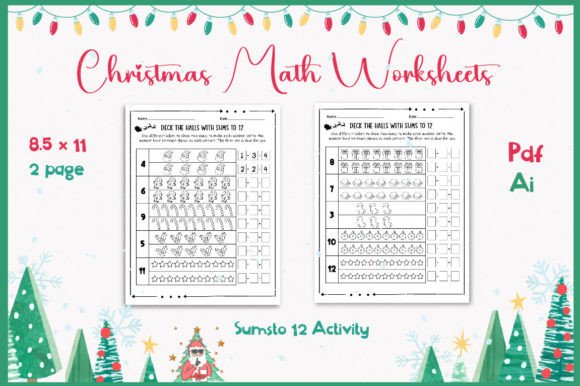
This particular printable set takes the abstract concept of number bonds and grounds it in a concrete, hands-on activity. Students are presented with Christmas-themed pictures—perhaps stockings, ornaments, or trees—each representing a total sum of 12. The task is twofold: first, to color and model two different ways to make that number using the festive images (e.g., coloring 8 stockings one color and 4 another to show 8 + 4 = 12). Second, they transition from the visual model to the abstract number sentence, writing the corresponding addition equation. This two-step process—visual modeling followed by symbolic representation—is excellent for cementing understanding. It caters to different learning styles, combining kinesthetic coloring with logical mathematical notation.
Practical Application and Educational Value
From a practical standpoint, the Christmas Math Worksheet Sums to 12 is designed with both educators and parents in mind. The package includes a PDF file with 2 pages formatted at 8.5" x 11", making it instantly ready for printing in any standard home or school printer. The editable nature of the file is a significant advantage, allowing teachers to potentially customize instructions or adapt the activity for different learners if needed. This flexibility is a key consideration when selecting educational printables.
The activity’s design promotes several key skills:
- Number Sense: By exploring multiple combinations to make 12, students develop a flexible understanding of numbers.
- Subitizing: Quickly recognizing the number of colored items in a group strengthens this foundational skill.
- Fine Motor Skills: The coloring component aids in developing hand-eye coordination and pencil control.
- Mathematical Communication: Translating a visual model into a written equation is a critical form of math communication.
The thematic element is more than just decorative; it’s strategic. Using familiar Christmas imagery reduces anxiety and increases engagement. A child who might be reluctant to do a generic addition drill is often more willing to color and write equations for a picture of a cheerful snowman. This positive association with math practice is invaluable for building a confident learner.
Choosing and Using This Resource Effectively
When integrating this worksheet into a lesson plan or home learning routine, consider its placement. It works beautifully as a morning warm-up activity during the weeks leading up to Christmas, as a math center task, or as meaningful homework that feels more like a game than an assignment. For maximum benefit, pair it with hands-on manipulatives. Have students first build the number bonds with physical counters (like mini ornaments or buttons) before they color the sheet. This multi-sensory approach reinforces the concept from multiple angles.
It’s also a fantastic tool for assessment. Observing how a student models the two different ways to make 12 can provide immediate insight into their understanding. Do they grasp that the parts must equal the whole? Can they systematically find pairs? The worksheet becomes a window into their mathematical thinking. For parents, it offers a clear, structured way to support learning at home without needing specialized training. The instructions are straightforward, and the festive format makes it a cooperative rather than combative activity.
Beyond First Grade: The Versatility of a Foundational Skill
While this resource is tailored for first graders, the skill of decomposing numbers is foundational for all future arithmetic. Mastery of sums to 12 paves the way for understanding sums to 20, subtraction facts, and eventually, more complex operations like multi-digit addition and multiplication. The Christmas Math Worksheet thus serves as a stepping stone. Its value extends beyond a single holiday season; it’s an investment in a child’s long-term numerical literacy.
For creators, homeschool educators, or small business owners in the educational space, understanding the design principles behind effective resources like this is key. The balance of clear visual hierarchy, age-appropriate imagery, and pedagogical soundness makes it a standout product. The clean, uncluttered layout ensures the child’s focus remains on the math, not on deciphering complicated instructions—a crucial aspect of instructional design.
In conclusion, the Christmas Math Worksheet Sums to 12 activity is a thoughtfully designed tool that accomplishes much more than keeping children busy during the holidays. It leverages festive appeal to deliver rigorous math practice, building number sense, fluency, and a positive attitude toward learning. By combining visual modeling, hands-on coloring, and written equations, it addresses multiple learning pathways, making it an effective and engaging resource for any first-grade math curriculum. Its practical format and editable feature make it a convenient and valuable addition to a teacher’s toolkit or a parent’s learning arsenal.